
Short answer: Facial massage for wrinkles gives real but small, mostly short-lived effects: more blood flow for minutes, less puffiness for hours, and modest firmness changes in a handful of tiny studies. No good study shows it erases wrinkles, and two systematic reviews say the evidence is not strong enough to call it effective.
Daily sunscreen and a retinoid do far more.
Facial massage for wrinkles means rubbing, pressing or rolling the skin of your face, by hand or with a tool, in the hope of softening lines. It feels lovely. Whether it smooths anything is a different question.
This guide is for anyone deciding whether a nightly face massage, a gua sha stone or a roller is worth their time. It covers what the studies actually found, what the American Academy of Dermatology, Harvard Health and Cleveland Clinic say, how to do it safely, and what works better.
The short verdict: enjoy face massage for wrinkles as a relaxing, low-risk habit that can make skin look fresher for a while. Do not expect it to remove lines, and do not skip sunscreen for it.
Does facial massage for wrinkles actually work?
Facial massage has small, measurable effects on blood flow and firmness, but there is not enough evidence to say it reduces wrinkles. That is the conclusion of the most recent systematic review we could find.
A 2025 systematic review in Aesthetic Surgery Journal Open Forum pooled 12 studies of mechanical facial rejuvenation, including manual massage and facial exercises, in 321 women aged 30 to 70.
It found some improvements in specific areas such as the cheeks, forehead and jawline. But it judged the studies to have a moderate risk of bias, and concluded the evidence is insufficient to establish that these techniques work with confidence.
So does facial massage reduce wrinkles? Possibly a little, in some people, for some time. Nobody has shown it convincingly, and the studies that exist are small.
What have studies found about facial massage and wrinkles?
Five studies are worth knowing, and every one of them is small, short or has a catch. Here they are side by side.
| Study | What was tested | Who and how long | What it found | The catch |
|---|---|---|---|---|
| Caberlotto, PLoS ONE, 2017 | An oscillating skin-massaging device plus cream, against cream alone | 42 women aged 65 to 75, twice daily for 8 weeks | Wrinkle scores improved by 0.31 points at 4 weeks and 0.25 at 8 weeks on a 10-point scale | Funded by L’Oréal, which sold the device |
| Miyaji, Complementary Therapies in Medicine, 2018 | A facial massage roller on one cheek | Two small groups, 5 minutes once, then daily for 5 weeks | Blood flow rose by up to about 25% for over 10 minutes | Wrinkles were not measured; run with a company’s R&D centre |
| Alam, JAMA Dermatology, 2018 | Facial exercises, not massage | 27 women aged 40 to 65 enrolled, 16 finished, 20 weeks | Estimated age fell from 50.8 to 48.1 years; fuller cheeks | No control group, many dropouts |
| Okuda, Skin Research and Technology, 2022 | Self-massage by hand | 5 adults aged 29 to 37, about 90 seconds twice daily for 2 weeks | CT scans showed slightly thinner, lifted cheeks | Five people, all young |
| Ahn, Journal of Cosmetic Dermatology, 2025 | Face roller against gua sha | 33 women aged 20 to 50, 10 minutes five times a week for 8 weeks | Both changed facial contour by 2 to 3 mm; the roller raised elasticity by 7.5% to 8.6% | No group that did nothing |
Read across the columns and a pattern appears. Something measurable happens, but nobody has yet run a large, independent trial with a proper comparison group and checked wrinkles over months.
The massage device study
The 2017 device study is the only one that measured wrinkles directly, and the improvement was small. In that PLoS ONE trial, older women who used a vibrating device with cream scored better on wrinkles than women who used the cream alone.
The same team massaged donated skin samples in the lab and saw more of the proteins skin uses for structure, including a building block of collagen. That is interesting biology, but skin in a dish is not a face in a mirror.
The study was funded by L’Oréal, which owned the device brand. That does not make it wrong, but independent studies carry more weight.
The blood flow and CT studies
Rollers and hand massage change blood flow and the shape of soft tissue a little, at least in the short term. In the roller study reported by ScienceDaily, five minutes of rolling raised blood flow in the massaged cheek by up to about 25%, and the effect lasted more than ten minutes.
After five weeks of daily rolling, blood vessels in that cheek widened better in response to heat. The study did not look at wrinkles at all.
The 2022 CT study scanned five people before and after two weeks of simple hand massage. Their cheeks were 0.8% thinner, and the high point of the cheek had shifted about 3.9 mm, 2.7 mm of it upwards. Five people is a promising start, not proof.
What do systematic reviews say about facial massage?
Both systematic reviews we found say the evidence is too weak to conclude these techniques work. A systematic review pulls together every study it can find and grades how trustworthy they are.
The 2025 review above included three manual massage studies. An earlier 2014 review in Aesthetic Surgery Journal looked at facial exercises and found nine reports, none with a control group or randomisation, and most measured by the authors or the patients themselves.
Its conclusion was that the evidence to date is insufficient, and that large randomised trials are needed. A decade later, the newer review said much the same.
What do the AAD, Harvard Health and Cleveland Clinic say?
None of the three recommends facial massage as a wrinkle treatment. People search for their views by name, so here is what each actually says.
The American Academy of Dermatology’s list of 11 ways to reduce premature skin aging does not mention massage. Its advice centres on daily sun protection, not smoking, gentle cleansing and moisturising.
Harvard Health quotes dermatologist Suzanne Olbricht, who says there are no good, rigorous studies showing face workouts are effective. She adds that they are not dangerous, but any benefit would be very subtle.
Cleveland Clinic dermatologist Shilpi Khetarpal, MD, says face rolling gives a temporary improvement in the texture and colour of skin. In other words, a nice glow, not a lasting change.
What are the real benefits of facial massage for wrinkles?
The best-supported facial massage benefits are more blood flow, less puffiness and relaxation, all of them temporary. Here is what you can reasonably expect.
- A short-term glow. The roller study measured more blood flow in the cheek for over ten minutes after five minutes of massage. That flush may be part of the fresh look people notice.
- Less morning puffiness. Cleveland Clinic says facial lymphatic drainage may increase circulation and reduce puffiness in the face. Its face roller article lists reduced puffiness too.
- Relaxation. Cleveland Clinic includes relaxation and stress relief among face rolling benefits, which is a fair reason on its own to do it.
- Better spread of skincare. Massaging in a moisturiser or serum spreads it more evenly, according to the same article.
- Possibly slightly firmer skin. The 2025 roller trial measured a 7.5% to 8.6% rise in skin elasticity after eight weeks. That is the closest thing to an anti-aging facial massage result, and it still needs confirming.
What is missing from that list is “fewer wrinkles”. Some websites repeat a claim that facial massage raises collagen by 20%, but we could not trace that figure to any study.
How do you do a facial massage for wrinkles at home?
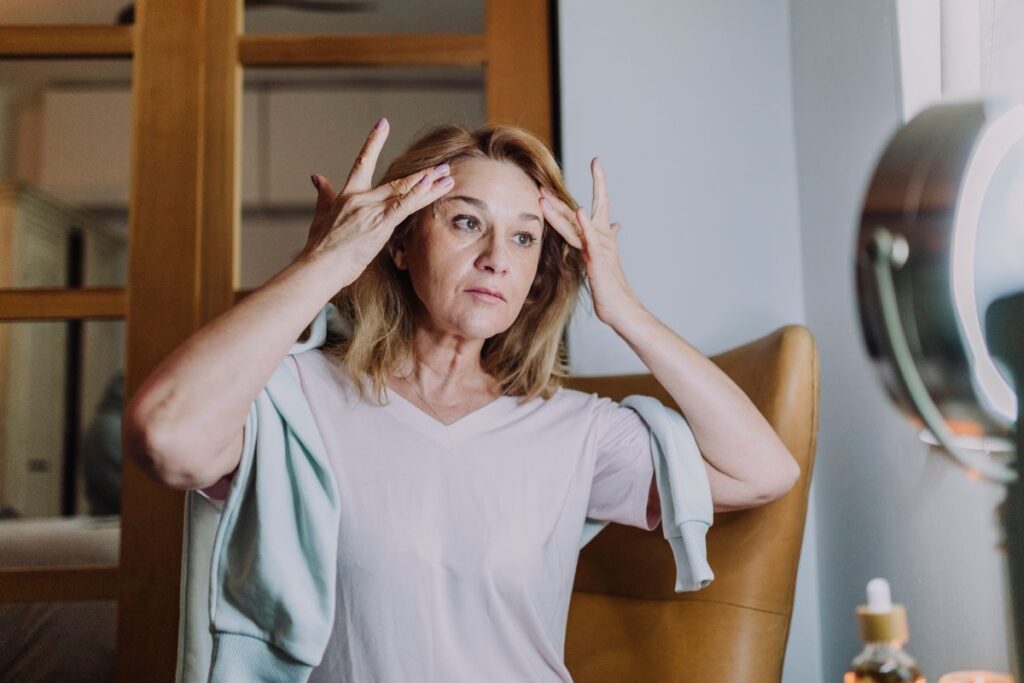
Use clean hands or a clean tool, a slippery moisturiser, very light pressure and slow strokes outwards from the centre of your face. Five minutes is plenty. This routine follows Cleveland Clinic’s guidance on rollers and gua sha.
- Wash your face and hands. Start with clean skin so you are not pushing grime around.
- Add slip. Apply your usual moisturiser, serum or a facial oil so fingers or tools glide instead of dragging.
- Start in the middle. Work outwards from the centre of your face towards your ears and hairline, which is the direction Cleveland Clinic describes for both rollers and gua sha.
- Go one way. Stroke in one direction, lifting off at the end, rather than rubbing back and forth.
- Keep the pressure light. You should feel a gentle glide, never a pull. Skin should not be dragged or turn red.
- Stay away from the eyes. Cleveland Clinic advises rolling away from the eyes rather than over them.
- Stop at about five minutes. Cleveland Clinic says five minutes daily or every other day is enough, and longer sessions do not improve results.
Forehead
For the forehead, place your fingertips between your brows and glide them slowly out towards your temples. Repeat a few times, moving a little higher each pass until you reach the hairline.
Keep it gentle. The AAD notes that repeatedly contracting the same facial muscles for years can make lines permanent, so aim to relax the area rather than work it.
Cheeks and jaw
For the cheeks, sweep from beside your nose out towards your ears, and along the jawline from the chin to below the ear. This is where the CT study saw its small lift, using simple hand massage.
Around the eyes
Around the eyes, use your ring finger and barely any pressure, or skip the area. The skin here is thin, and a massage that tugs it is doing more harm than good.
Do gua sha and face rollers work better than hands for wrinkles?
Tools are not proven to beat hands, but the only head-to-head trial found rollers and gua sha work in slightly different ways. Both are cheap, and neither is essential.
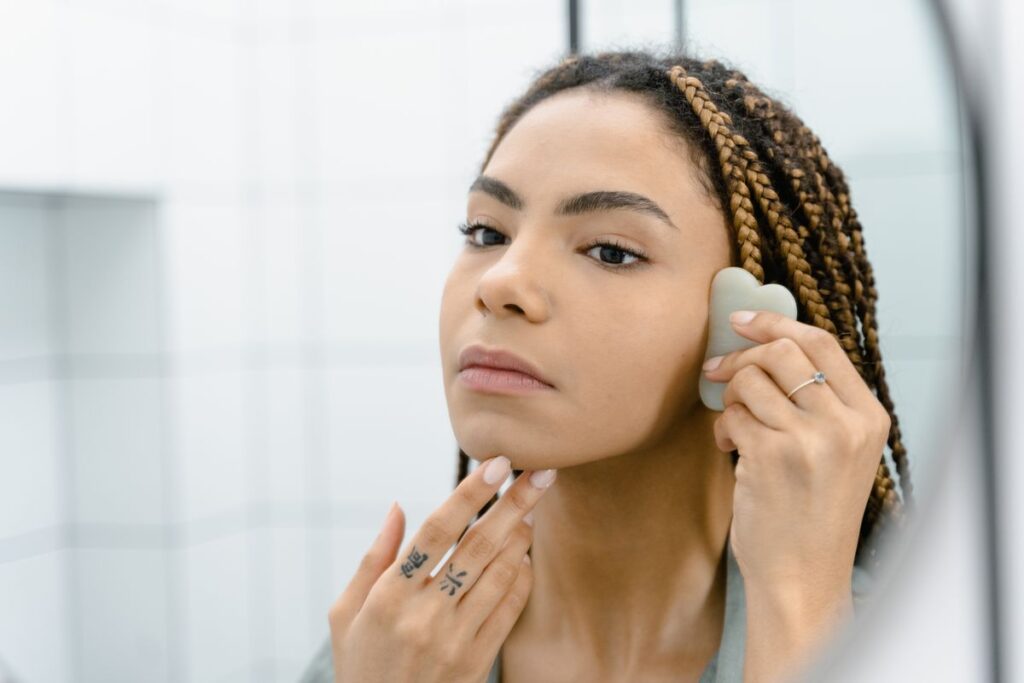
In the 2025 randomised trial, women used either the roller end or the gua sha end of the same tool for ten minutes, five times a week, for eight weeks.
Both groups saw facial contours change by about 2 to 3 mm. The roller group gained skin elasticity, while the gua sha group had lower muscle tone and stiffness.
The weak point is that there was no group who did nothing, so some of that change could have happened anyway. The researchers also noted the study ran for only eight weeks.
Gua sha for wrinkles
Gua sha for wrinkles has no direct evidence, but it is a reasonable massage tool if you use it very gently. Cleveland Clinic’s gua sha guide describes it as tool-assisted massage that increases microcirculation where it is used.
On the face, it advises moisturiser first, very light pressure, moving outward from the centre in one smooth direction, and avoiding swollen areas.
Face rollers
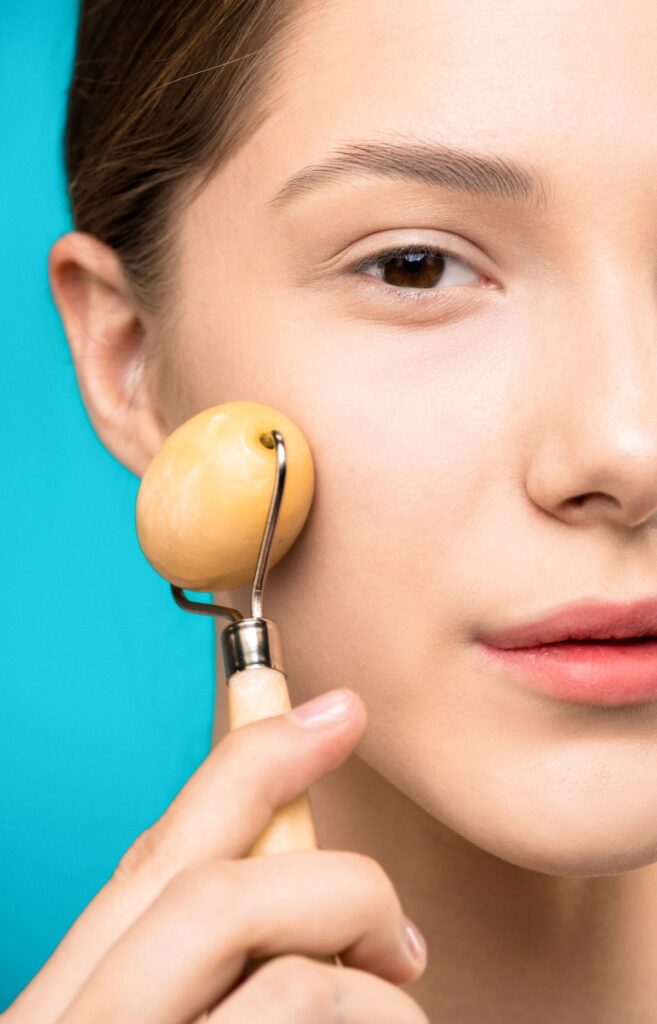
A face roller is the gentlest tool, and the one with the blood flow study behind it. Cleveland Clinic suggests keeping it in the fridge for a cooling effect and cleaning it with rubbing alcohol after each use.
Can facial massage for wrinkles cause wrinkles or other problems?
We found no study showing that gentle facial massage causes wrinkles, but rough rubbing, bruising and some health conditions are real concerns. The risk comes from technique and from who is doing it.
Rough handling irritates skin. The AAD says scrubbing can irritate your skin, and that irritating your skin accelerates skin aging. Gentle is the whole point.
Cleveland Clinic warns that people with mature or fragile skin should avoid aggressive rolling, which can bruise. Gua sha can cause soreness, bruising or skin discolouration.
Check with a doctor before gua sha if you have circulation problems, diabetes, eczema or psoriasis, take blood thinners, are having chemotherapy, or are pregnant. That list comes from Cleveland Clinic.
Lymphatic drainage massage has its own list. Cleveland Clinic says to avoid it with blood clots, cellulitis, fever, heart disease, infection, kidney failure or after a stroke.
Is facial massage the same as face yoga or facial exercise?
No. Facial massage works on the skin and soft tissue from the outside, while facial exercise or face yoga works the muscles from the inside. The evidence for each is different, and they are often confused.
The best-known study here is the 2018 JAMA Dermatology trial of 32 facial exercises. Women who kept going for 20 weeks were judged almost three years younger on average from their photos, with fuller upper and lower cheeks.
Only 16 of the 27 who started finished, and there was no comparison group. It is encouraging, not settled, and it was about exercise, not massage.
There is also a possible tension. The AAD links wrinkles to repeating the same facial expressions for years, so exaggerated face-pulling may not be the gentle fix it looks like. Sadly, your face will not get a six-pack.
What actually reduces wrinkles, according to dermatologists?
Daily sunscreen, a retinoid and a good moisturiser have far better evidence than facial massage. These come straight from the American Academy of Dermatology.
- Sunscreen every day. The AAD’s wrinkle remedies advice is a broad-spectrum sunscreen or moisturiser with SPF 30 or higher, daily.
- A retinoid. The AAD says retinoids speed up skin cell turnover, boost collagen and reduce fine lines. Retinol is sold over the counter; tretinoin, tazarotene and trifarotene need a prescription.
- Moisturiser. The AAD says moisturiser can plump up fine lines immediately, by trapping water in the skin.
- No smoking. The AAD says smoking greatly speeds up skin aging and causes wrinkles.
- Fewer repeated expressions. Sunglasses help reduce lines caused by squinting, according to the AAD.
- Patience. Most products take at least six weeks to work, and sometimes three months.
Retinoids are not for everyone. The AAD says they should not be used during pregnancy, can irritate skin and make it more sensitive to the sun, and can trigger dark patches in darker skin when they irritate.
Red light therapy sits somewhere in between. Our guide to whether red light therapy works covers a controlled trial that found modest improvements in fine lines, and how often to use red light therapy covers the schedules studies used.
So think of facial massage for wrinkles as the pleasant extra, and sunscreen as the part that actually protects your skin.
Do facial massage devices work for wrinkles?
Vibrating and microcurrent face devices have even less independent evidence than hand massage. The one wrinkle study on a vibrating device was funded by the company that sold it, and it found a small effect.
If you like the idea of a device, treat it as a more consistent, less tiring way to massage, not a wrinkle cure. What matters most is that it is gentle and that you actually use it.
We sell three face and neck devices, and we describe them only by what they do. Our Face Lift Massager uses micro-vibration and is used over serum for 10 to 15 minutes, three to five times a week.
Our Facial Skincare Device combines EMS, red and blue LED light, sonic cleansing and a cooling mode. Our Neck Beauty Device uses gentle micro-vibration shaped for the neck and jawline.
None of our devices has been tested in a published wrinkle study. If a studied result matters most to you, sunscreen and a retinoid come first.
How long does facial massage take to show results?
Facial massage shows a glow within minutes, but any change to firmness took weeks in studies, and even that was small. The timeline depends on what you are looking for.
- Minutes: more blood flow and a flushed, fresh look, lasting over ten minutes in the roller study.
- Hours: less puffiness and a smoother texture. Cleveland Clinic calls this a temporary improvement.
- Two weeks: small shape changes on CT scans in the five-person study.
- Eight weeks: small elasticity and wrinkle score changes in the roller and device trials.
- Twenty weeks: fuller cheeks in the facial exercise study, which was exercise rather than massage.
If you try facial massage for wrinkles, take a photo in the same light before you start and again after eight weeks. Small changes are easy to miss, and just as easy to imagine.
Frequently asked questions
Does facial massage stimulate collagen?
Not proven in living faces. The 2017 study found more collagen-related proteins in massaged skin samples in a lab, but the commonly quoted claim that massage raises collagen by 20% does not trace back to any study we could find.
Can facial massage get rid of forehead wrinkles?
No study shows it can. Gentle massage may help the forehead feel relaxed, but lines there come from repeated expressions and sun damage, among other things. Sunscreen and a retinoid have better evidence.
How often should you do a face massage for wrinkles?
About five minutes daily or every other day, according to Cleveland Clinic’s advice on face rollers. Longer sessions do not improve results. The studies used anything from 90 seconds twice a day to ten minutes five times a week.
Should you massage your face upwards or outwards?
Outwards from the centre of your face, in one direction, is what Cleveland Clinic describes for both rollers and gua sha. The popular advice to always stroke upwards to fight gravity has no study behind it that we could find.
Does facial massage help sagging skin?
Perhaps slightly. The 2022 CT study saw the high point of the cheek shift upwards by under 3 mm after two weeks, and the 2017 device study found a small improvement in neck sagging. Both effects were small, and neither study was large.
Is gua sha or a jade roller better for wrinkles?
Neither is proven for wrinkles. In a 2025 trial, the roller improved skin elasticity more, while gua sha relaxed muscle tone more. Rollers are gentler, and gua sha is more likely to bruise if you press hard.
Is it bad to massage your face every day?
Not if you are gentle. Cleveland Clinic says daily rolling is fine for about five minutes. Stop if your skin turns red, sore or bruised, and go lighter next time.
Can I do gua sha or facial massage while pregnant?
Check with your doctor or midwife first. Cleveland Clinic lists pregnancy among the reasons to avoid gua sha. Light hand massage with a moisturiser is a gentler option to ask about.
Final thoughts
Facial massage for wrinkles is a pleasant, low-risk habit with small, mostly temporary effects. It can make skin look fresher and less puffy, and a few small studies found modest changes in firmness, but nothing shows it removes lines.
If you want to relax and look a little brighter, five gentle minutes with clean hands or a roller is a lovely end to the day.
If you want fewer wrinkles, start with daily SPF 30 sunscreen and ask a pharmacist or dermatologist about a retinoid. Those have the evidence massage lacks.
If you prefer a device, choose one you will use gently and consistently, such as our Face Lift Massager, and treat it as massage made easier rather than a treatment.
If you bruise easily, take blood thinners, have a skin condition or are pregnant, check with a doctor before gua sha or firm massage.
Massage your face because it feels good. Wear sunscreen because it works.