Short answer: A clinic charges you per session, per body area, forever. A home device is one purchase. The American Society of Plastic Surgeons puts the average laser skin treatment at $697, and that is before you multiply it by the six to eight sessions most courses need.
Working out the real IPL cost, whether at a clinic or at home, is annoying, because almost nobody quotes you the number that actually matters.
Clinics advertise a price per session. You need a lot of sessions. Nobody puts that on the poster.
Here is how the IPL cost genuinely works, so you can compare properly instead of guessing.
What does laser hair removal actually cost?
The American Society of Plastic Surgeons puts the average laser skin treatment, including hair removal, at $697.
Two things about that number matter enormously.
First, ASPS says plainly that this figure “is only part of the total price” and does not include other related expenses. It is a starting point, not a bill.
Second, it is an average across laser skin treatments generally, not a price list for your legs at your local clinic.
Real quotes swing wildly. A session in a big city can cost several times what the same session costs an hour down the road.
So treat any single national IPL cost figure with suspicion, including that one. What you need is the structure underneath it.
Why the IPL cost question has no single answer
Clinic pricing has three moving parts, and they multiply rather than add. That is the whole trick.
You pay per area. Underarms, bikini line, half legs, full legs, face. Each is quoted separately, so treating four areas means four bills.
You pay per session. Hair only responds while it is actively growing, so no single session catches all of it. Clinics normally recommend six to eight, spaced weeks apart.
You pay again later. Laser gives long-term reduction, not permanent removal. Most people go back for top-ups indefinitely.
So the real IPL cost comparison is never “what does one session cost”. It is price per session, times sessions, times areas, plus top-ups forever.
A quote that looks perfectly reasonable on its own becomes a genuinely large number once you finish that multiplication. This is where people get caught.
What makes the IPL cost go up or down?
Clinic quotes vary for reasons that are mostly not mysterious. ASPS lists four things that move the price.
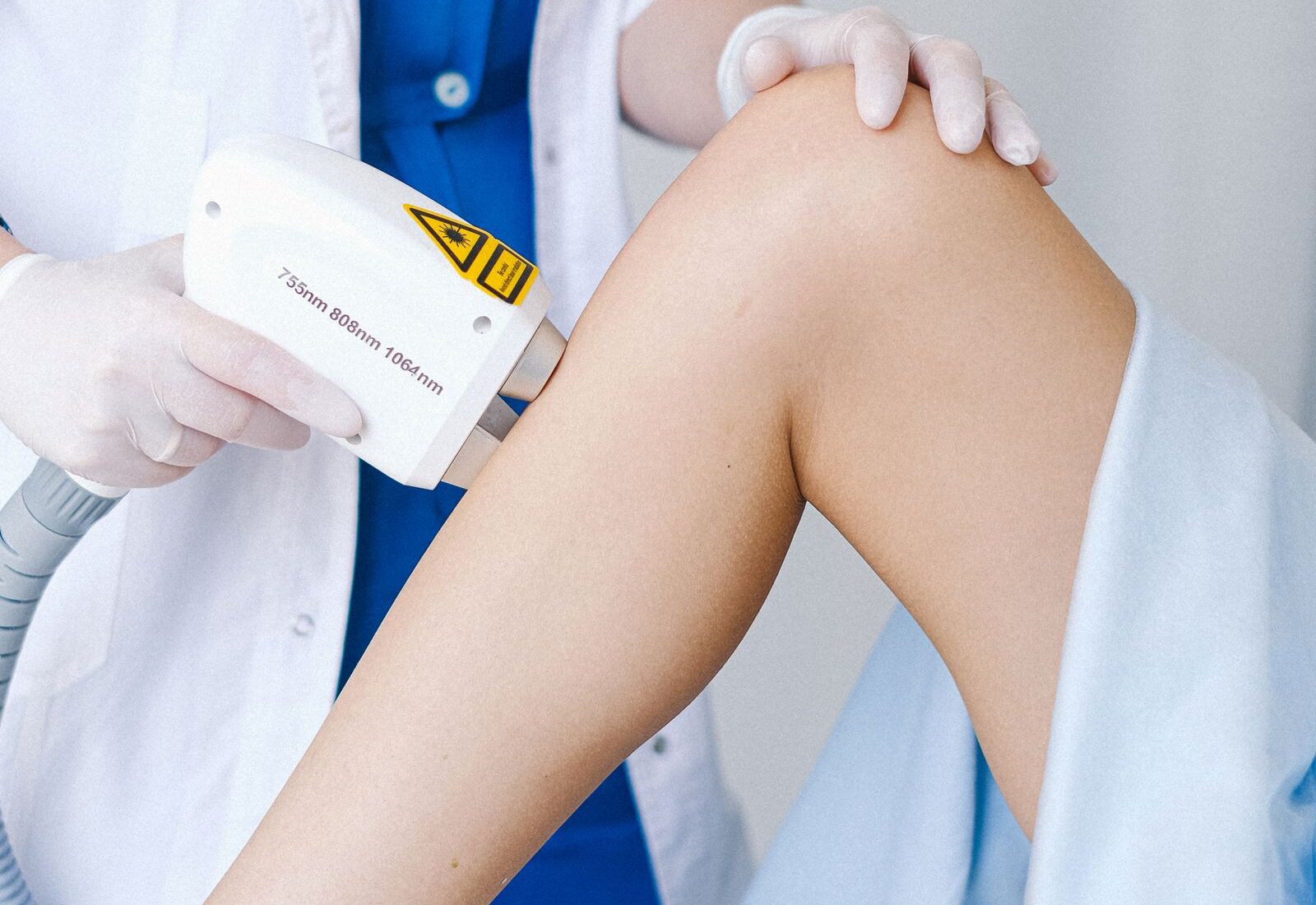
Who is holding the machine. A doctor-led clinic charges more than a beauty salon, because you are paying for qualifications and experience as much as for the laser.
Which machine it is. Different laser types cost the clinic different amounts to buy and run, and that lands on your bill.
How long it takes. Full legs occupy a room and a technician for far longer than an upper lip, so they are priced accordingly.
Where you live. This is the big one. City-centre rent shows up in your session price whether you like it or not.
None of those four apply to a home device. That is really the whole reason the at-home IPL cost looks so different: you are not renting a room, a machine or a person.
IPL cost by body area
Clinics price by how long an area takes, which means the cost ladder is fairly predictable even when the exact numbers are not.
- Small areas such as upper lip, chin and underarms sit at the cheap end. They take minutes.
- Medium areas such as bikini line, half legs and arms sit in the middle.
- Large areas such as full legs, back and chest are the expensive end, because they take the longest.
- Full body is where clinic pricing really bites, since you are stacking several areas and paying for each across every session.
This ladder is exactly where a home device pulls ahead. At a clinic, adding your legs to your underarms roughly multiplies the bill.
At home, adding your legs costs you twenty extra minutes and nothing else. The more of your body you want treated, the more lopsided the IPL cost comparison becomes.
Work out your own IPL cost comparison
Take a real quote from a clinic near you, then fill in these four lines.
- Price per session for the area you actually care about.
- Times the number of sessions they recommend. Usually six to eight.
- Times the number of areas you want done.
- Plus top-ups, at least once or twice a year, for as long as you want to stay smooth.
That total is your honest comparison figure. It is almost always far bigger than the number on the price list, because the price list only ever shows you line one.
Do this before you book anything. Ten minutes with a calculator has saved a lot of people a lot of money.
How at-home IPL cost works
A home device turns that multiplication into a single purchase.
The structure flips completely:
- Areas are free. Legs, underarms, bikini line and face all cost the same as doing one area, which is to say nothing extra.
- Sessions are free. A full course, and every top-up for years afterwards, adds nothing to the IPL cost.
- Maintenance is free. The top-ups that keep quietly billing you at a clinic are just included.
The one thing worth checking is flash capacity. Modern handsets are rated in the hundreds of thousands of flashes, which for one person is effectively a lifetime.
Our own IPL Laser Hair Removal Handset is $99, with no cartridges, refills or replacements to buy later.
IPL cost vs clinic laser, side by side
| Clinic laser | At-home IPL | |
|---|---|---|
| How you pay | Per session, per area | Once |
| Sessions needed | 6 to 8, each charged | 8 to 12 weekly, no extra cost |
| Extra body areas | Charged separately | Free |
| Top-ups later | Charged every time | Free |
| Travel and time off | Appointments, travel, waiting | None |
| Power per pulse | Higher | Lower, for safety |
| Sessions to results | Fewer | More |
| Who operates it | Trained technician | You, in your bathroom |
What the extra money buys at a clinic
It would be dishonest to pretend the higher clinic IPL cost buys you nothing. It buys real things.
More power. Professional machines run at energy levels no device sold for home use is allowed to reach. That means fewer sessions and often a more complete result.
Someone trained. A person who reads your skin and hair, picks the settings, and reaches the awkward spots you cannot see. Missed patches are a very common reason home results look uneven.
More skin tones covered. Clinics carry several laser types, including wavelengths considered safer for deeper skin. If at-home IPL is not suitable for your skin, a clinic may still be able to treat you. This is a genuine and important advantage.
Speed. A handful of appointments instead of three months of weekly sessions on your sofa.
Hidden costs to check before you buy
Both routes have small print. These are the ones that change the IPL cost after you have committed.
At a clinic: ask whether the quote covers a full course or a single visit, whether consultations and patch tests are charged, and what a top-up costs in two years.
With a home device: check whether it needs replacement cartridges, what the flash count actually is, and whether the plug and cable can be replaced if they fail.
That last one matters more than people expect. A working handset you cannot power is an expensive paperweight.
Which is better IPL cost value for you?
A home device is likely better value if you want several areas treated, you have dark hair on light or medium skin, and you can be consistent for two or three months.
A clinic is likely better value if your skin tone falls outside the safe range for home IPL, you want one small area sorted quickly, or you would simply rather a trained person did it.
For a lot of people the sensible move is to start at home. If it works, you have avoided a four figure course. If it does not, you found out cheaply.
Before you decide either way, read does at-home IPL actually work?, because the thing that decides your result is your hair colour and skin tone, not your budget.
Our handset comes with a 90-day money-back guarantee, which is deliberately longer than the point where you can tell whether it suits you.
Frequently asked questions
How much does laser hair removal cost on average?
The American Society of Plastic Surgeons puts the average laser skin treatment, including hair removal, at $697. ASPS notes this is only part of the total price and excludes other expenses. It is also a single figure, while most courses need six to eight sessions.
Is at-home IPL cost cheaper than a clinic?
Almost always, once you multiply sessions by body areas and add years of top-ups. The gap grows the more areas you want treated, because a home device charges nothing extra for them.
How many clinic sessions will I need?
Six to eight is the usual recommendation, though it depends on your hair, the area and your hormones. Always ask a clinic to quote the full course rather than one session.
Are there hidden costs with a home IPL device?
Sometimes. Check whether it needs replacement cartridges, what the total flash count is, and whether spare plugs and cables are available. Ours needs no cartridges or refills.
Does a higher IPL cost mean a better home device?
Not reliably. Flash capacity, energy output and whether it suits your skin tone matter far more than the price tag.
Can I use a home device to maintain clinic results?
Yes, and it is a sensible combination. Pay a clinic for the heavy lifting, then handle top-ups at home instead of paying per visit for years.
Why is clinic laser so expensive?
Equipment, trained staff, insurance, premises and time. It is charged per session because that is genuinely how the treatment works, not because clinics are being awkward.
Does IPL cost more in some countries?
Yes, a lot more. Clinic pricing varies hugely by country and even by neighbourhood, which is exactly why you should run the calculation on a local quote rather than trusting a national average.