
Short answer: For most people, every two to three days is a sensible gap for legs and underarms, and every three days for the bikini line. If your skin is sensitive or prone to bumps, stretch that to about once a week, and never shave over skin that is still irritated. Change your blade after 5 to 7 shaves, so the more often you shave, the more often you replace it.
How often should you shave? It comes down to the number of days to leave between shaves so your skin stays smooth without getting sore, bumpy or itchy.
This guide is for anyone shaving their legs, underarms or bikini line who wants a simple rule instead of guessing, and who is wondering whether shaving every day is doing damage.
It covers why there is no single answer, a suggested gap for each body area and skin type, when to stop shaving for a while, how often to change your razor, and how to shave less often altogether.
The short verdict: leave two to three days between shaves on legs and underarms, about three days on the bikini line, and about a week if your skin reacts. Let your skin, not the calendar, have the final say.
Why is there no single answer to how often you should shave?
There is no single answer because two different clocks are running: how fast your stubble comes back, and how fast your skin recovers from the last shave. The right gap is wherever those two meet for you.
The first clock is quick. The Cleveland Clinic says shaving results typically last one to three days before hair starts to grow back.
The second clock is slower and varies more. Every shave drags a blade across the skin, and a shave on skin that has not settled from the previous one is where razor burn, bumps and ingrown hairs tend to come from.
That is why a rule like “shave whenever you see stubble” goes wrong. Your stubble can be ready in a day while your skin needs three.
So the honest answer to “how often should you shave?” is a range of days, adjusted for the area and for how your skin reacts.
Hair colour plays a part too. Dark hair on pale skin shows stubble sooner, so it feels like you need to shave more often even when the hair grows at the same speed.
How often should you shave each body area?
Use this table as a starting point for how often you should shave each area, then adjust it for your own skin. The gaps come from dermatologist and esthetician advice quoted further down.
| Body area | Suggested gap if skin copes well | Suggested gap if skin is sensitive | Why this area is different |
|---|---|---|---|
| Legs | Every 2 to 3 days | About once a week | Biggest area, so the most blade contact per shave |
| Underarms | Every 2 to 3 days | About once a week | Skin folds and rubs against itself and clothing |
| Bikini line and pubic hair | Every 3 days | No more than once a week | Coarser, curlier hair that is more likely to grow back in |
| Any area with active bumps or razor burn | Wait until it has settled | Wait until it has settled | Shaving over irritation makes it worse |
These are gaps, not targets. If a longer gap suits you, there is no health reason to shave more often.
How often to shave legs

Every two to three days is a reasonable gap for most people shaving their legs. Go longer if your legs get red, dry or bumpy afterwards.
Licensed medical esthetician Jordana Mattioli, speaking to InStyle, recommends at least two to three days or longer between shaves. She also notes that most people have some stubble three to five days after a shave.
Legs are the biggest area most people shave, so each session means a lot of blade contact. That makes them the area where a blunt razor or a rushed dry shave does the most damage.
If the backs of your legs show dark dots after shaving, our guide on how to get rid of strawberry legs explains what they are, and why shaving more often will not clear them.
How often to shave armpits
Every two to three days works for most underarms, and about once a week if they sting or itch after shaving. The underarm is small, but the skin is delicate and constantly rubbed.
None of the dermatology sources we checked gives a separate number for underarms, so the same general two to three day gap applies. What changes is how carefully you shave.
Hair in the armpit often grows in more than one direction. The American Academy of Dermatology advises shaving in the direction the hair grows, so it can take a few short strokes rather than one long one.
Afterwards, the AAD recommends a fragrance-free moisturiser to reduce dryness and irritation. That is worth doing on underarms in particular, which spend the day rubbing against themselves and your clothes.
How often should you shave pubic hair?
About every three days is fine for the bikini line if your skin tolerates shaving, and no more than once a week if it is sensitive. That is the advice of a board-certified dermatologist, and this is the area where going too often costs the most.
Naeha Gupta, DO, told InStyle that for those who tolerate shaving with no issues, shaving every three days is fine, and for those with sensitive skin she recommends shaving no more than once per week.
The hair itself is part of the reason. The Cleveland Clinic explains that pubic hair tends to be coarser and curlier than other body hair, which makes it more likely to curve back into the skin as an ingrown hair.
Care matters as much as timing here. The American Academy of Dermatology says 1 in 4 people have injured themselves while grooming their pubic hair, and suggests standing while you trim so you can see what you are doing.
If you do not need the skin completely smooth, trimming instead of shaving between shaves avoids blade contact altogether. If the bikini line is already sore, see our guide to razor burn on the bikini area first. For every other way to deal with bikini hair, see bikini line hair removal methods compared.
Is it bad to shave every day?
Shaving every day is not dangerous, but it gives your skin no time to recover, so it raises the chance of razor burn, bumps and ingrown hairs. If you can avoid it, avoid it.
The NHS advice on ingrown hairs is plain: do not shave every day, if possible. It also advises against shaving too close, saying that leaving at least 1mm of stubble can help reduce ingrown hairs.
Board-certified dermatologist Ahuva Cices, MD, told InStyle that shaving may lead to local inflammation, irritation and even cuts in the skin, which can make infections more likely.
Some people shave daily with no problems at all. If your skin stays calm, that is your answer, but if every shave leaves it red, itchy or bumpy, frequency is the first thing to change.
If you are shaving every day because you want to look completely smooth, the NHS suggests trying an electric razor rather than wet shaving for people who get ingrown hairs.
How often should you shave if your skin is sensitive?
If your skin is sensitive, shave about once a week, and in general the more your skin reacts to shaving, the longer the gap should be. Your skin’s reaction after the last shave is the most reliable guide you have.
- Skin that stays calm: every two to three days for legs and underarms, every three days for the bikini line.
- Sensitive or easily irritated skin: about once a week, following Dr Gupta’s advice for sensitive skin, with a shaving cream labelled for sensitive skin, which the AAD suggests.
- Prone to razor bumps or ingrown hairs: longer gaps, a sharp blade and leaving a little stubble, as the NHS advises. Our guide on how to prevent razor bumps goes further.
- Coarse or curly hair: treat it like the bikini line, because the Cleveland Clinic links curlier hair to more ingrown hairs.
- Dry skin: moisturise after every shave, and itchy dry legs are a sign to space shaves out. Our guide on how to stop itching after shaving helps sort out the cause.
When should you take a break from shaving?
Take a break from shaving whenever the skin is still irritated, bumpy or infected, and restart only once it has fully settled. This is the rule that overrides any schedule.
DermNet advises that shaving should be avoided until any irritation has resolved. Shaving over red, stinging skin simply adds more friction to the problem.
Ingrown hairs are the same. The Cleveland Clinic warns that continuing to remove hair on top of an ingrown hair can make it worse, and our guide on how to treat ingrown hairs covers what to do instead.
Folliculitis needs the longest pause. For folliculitis caused by hair removal, DermNet advises stopping and not starting again for about three months after it has settled.
A break is not wasted time. Trimming with scissors or a trimmer keeps things tidy without a blade touching the skin.
How often should you change your razor?
Change your blade or throw away a disposable razor after 5 to 7 shaves, which means how often you shave decides how often you replace it. A blunt blade undoes all the good of a sensible gap.
That is the advice of the American Academy of Dermatology, which says to change the blade after 5 to 7 shaves to minimise irritation. The Cleveland Clinic adds that dull razors are more likely to cause ingrown hairs.
Here is what the 5 to 7 shave rule works out to in practice:
| How often you shave | Shaves per week | Change the blade about every |
|---|---|---|
| Every day | 7 | Week |
| Every other day | 3 to 4 | 2 weeks |
| Every 3 days | 2 to 3 | 2 to 3 weeks |
| Once a week | 1 | 5 to 7 weeks |
Treat those as the latest point, not the goal. DermNet advises changing blades as soon as they become blunt, so if a razor starts tugging or leaves you sore, replace it early.
Look after the razor between shaves too. The AAD recommends storing it in a dry area so it dries out completely, which helps stop bacteria growing on it, and advises not sharing hair removal products.
How do you make a shave last longer?
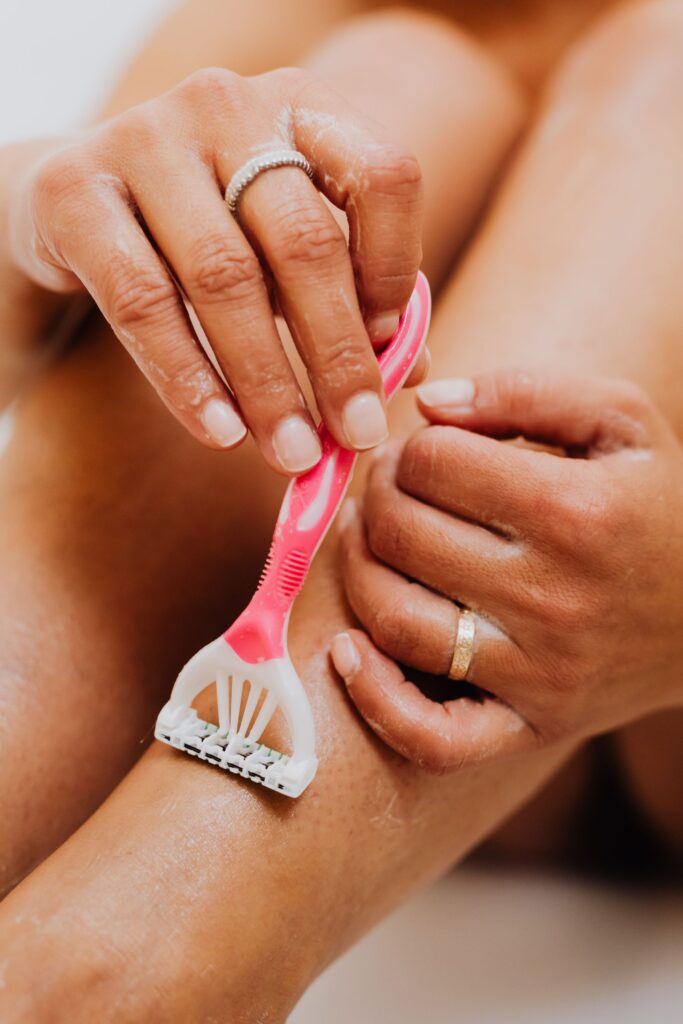
You cannot slow down how fast hair grows, but a careful shave stays comfortable for longer, which makes a longer gap easier to live with. Most of it comes down to preparation.
- Shave after a shower. The AAD says to wet your skin and hair first, and that right after a shower is a good time, when skin is warm and moist.
- Use a shaving cream or gel. DermNet suggests leaving it on for 2 to 3 minutes before you start.
- Shave with the grain. The AAD calls shaving in the direction hair grows an important step against razor bumps and burns. Going against the grain gives a closer shave at a cost, as shaving against the grain explains.
- Rinse after each swipe. Both the AAD and the NHS recommend it, so hair and cream do not clog the blade.
- Moisturise afterwards. The AAD recommends a fragrance-free moisturiser to reduce dryness and irritation.
One thing that does not change: shaving more often will not make your hair grow back faster or thicker. The Cleveland Clinic calls hair growing back longer after shaving a myth, and our post on whether shaving makes hair grow back thicker goes through the evidence.
How can you shave less often?
To shave less often, trim between shaves, or switch to a method that removes hair for longer, such as waxing, laser or IPL. Each has its own trade-off.
Trimming keeps hair short without a blade on the skin. It is the simplest way to stretch the gap on the bikini line.
Waxing lasts much longer. The Cleveland Clinic says one waxing session can create results that last three to four weeks, although DermNet lists waxing among the triggers for folliculitis as hair regrows.
Hair removal cream is one of the alternatives the NHS suggests for people who get ingrown hairs from shaving.
Laser and IPL reduce how much hair grows back, so there is less to shave. The NHS mentions laser treatment as a longer-term option for ingrown hairs, and the AAD suggests asking a dermatologist about laser hair removal.
Light-based hair removal gives permanent hair reduction rather than total removal, as our guide to whether IPL is permanent explains.
Dark hair on light to medium skin is where our IPL Laser Hair Removal Handset works, reducing regrowth over a course of sessions so you can shave far less often.
Deeper skin tones are not suited to most home IPL devices, ours included, and a clinic offering Nd:YAG laser is the safer route. Grey, white or red hair has too little pigment for light to target, so electrolysis is the option.
Check which skin tones and hair colours IPL works on before buying anything.
What if shaving is already causing a problem?
If shaving is already causing a problem, start with the guide below that matches it, because each one covers a single shaving problem in depth. Getting the gap between shaves right prevents most of them.
- Razor bumps: who gets them, and how to shave so they stop coming back.
- Razor burn on the bikini area: how to calm a red, stinging rash fast.
- Ingrown hairs: how to treat them without picking, and how to tell if one is infected.
- Itching after shaving: how to work out the cause from when the itch started.
- Strawberry legs: what the dark dots are, and which fix matches which cause.
- Shaving against the grain: what a closer shave costs your skin.
- Does shaving make hair grow back thicker? What the studies found, and why the myth feels true.
Frequently asked questions
How long does a shave last?
Usually one to three days before hair starts to grow back, according to the Cleveland Clinic. Dark hair on pale skin tends to show stubble sooner.
Is it OK to shave every other day?
For most people, yes. It sits within the two to three day gap an esthetician recommended to InStyle. If your skin gets red or bumpy, move to every three days or longer.
Can I shave my bikini line every day?
It is best not to. A board-certified dermatologist told InStyle that every three days is fine if you tolerate shaving, and no more than once a week for sensitive skin. Pubic hair is also more prone to ingrown hairs.
Does shaving more often make hair grow faster?
No. Shaving cuts hair at the surface and does not change how fast it grows. The Cleveland Clinic calls the idea that hair grows back longer after shaving a myth.
How often should I change my razor if I shave my legs every day?
About once a week. The American Academy of Dermatology advises changing blades after 5 to 7 shaves, and sooner if the blade tugs or leaves your skin sore.
Should I shave before or after a shower?
At the end of it, or straight after. The AAD says a good time to shave is right after a shower, when your skin and hair are warm, wet and softer.
Is trimming better than shaving?
It is gentler, because no blade touches the skin. It does not leave skin smooth, but it is a good way to stay tidy between shaves or while irritated skin heals.
Will IPL mean I can shave less often?
For dark hair on light to medium skin, it reduces regrowth over a course of sessions, which means fewer shaves. Deeper skin tones should look at clinic Nd:YAG laser, and light hair at electrolysis.
Final thoughts
How often should you shave? As often as your skin can fully recover in between. For most people that is two to three days on legs and underarms and about three days on the bikini line.
If your skin stays calm, keep to that gap and change your blade after 5 to 7 shaves.
If your skin gets red, itchy or bumpy, stretch to about once a week, leave a little stubble, and do not shave again until it has settled.
If you are shaving almost daily and still want smoother skin, the real fix is less hair, not more shaving. For dark hair on light to medium skin, our IPL handset is the at-home route; for deeper skin tones, a clinic Nd:YAG laser; and for light hair, electrolysis.